
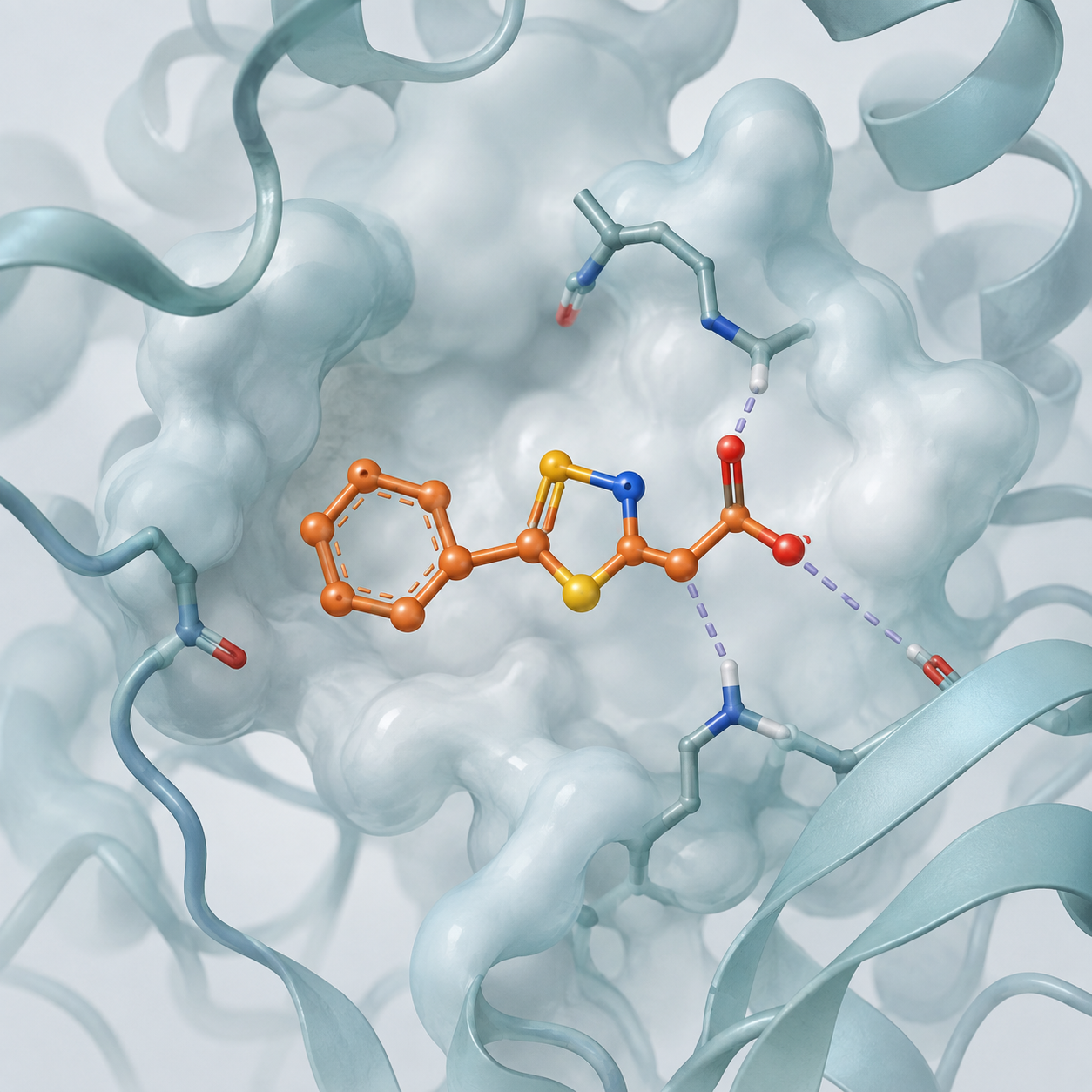
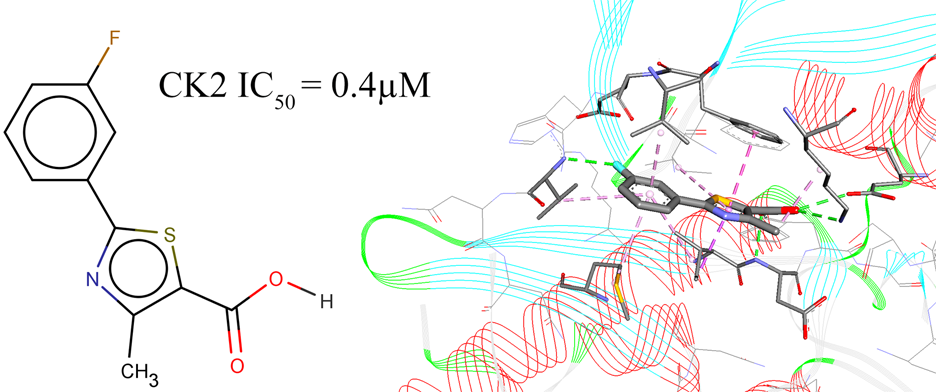
Virtual screening identified novel protein kinase CK2 inhibitors among 1,3-thiazole-5-carboxylic acid derivatives. The most active compound, 2-(3-fluorophenyl)-4-methyl-1,3-thiazole, inhibited CK2 with an IC50 value of 0.4 μM. Ligand-efficiency values for the investigated derivatives ranged from 0.45 to 0.56 kcal mol−1 per non-hydrogen atom. Given that 0.3 is generally considered the lower threshold for ligand efficiency, the identified CK2 inhibitors represent promising candidates for lead optimization. A binding mode for this compound class within the ATP-binding site of protein kinase CK2 was proposed (Figure 1).
Publication
Protopopov MV, Volynets GP, Starosyla SA, Vdovin VS, Lukashov SS, Bilokin YV, Bdzhola VG, Yarmoluk SM. Identification of 1,3-thiazole-5-carboxylic acid derivatives as inhibitors of protein kinase CK2. Current Enzyme Inhibition. 2018;14(2):152–159.