Establishment of the Department
The Department of Biomedical Chemistry at the Institute of Molecular Biology and Genetics of the NAS of Ukraine was formally established on 5 May 2003 as the Department of Combinatorial Chemistry of Bioactive Compounds. It grew out of the Nucleic Acid Chemistry Group and was founded by Professor Sergiy Yarmoluk, who has led the department ever since.
The new unit was created to integrate modern organic and medicinal chemistry with molecular biology, biochemistry and computational modelling for the discovery of novel bioactive compounds and prospective therapeutics.
Formation of a Scientific School
The department’s scientific roots reach back to the 1980s and research in nucleic acid chemistry, including synthetic methods for modified oligonucleotides and oligonucleotide–peptide conjugates. In 1996, the Nucleic Acid Chemistry Group was established at IMBG under the leadership of Sergiy Yarmoluk.
In the mid-1990s, the team launched a new research programme on fluorescent probes for nucleic acids and proteins. This work centred on cyanine dyes whose spectral properties change upon interaction with biomolecules. It established a scientific school in molecular fluorescence, generated numerous publications, trained early-career researchers and led to international patents covering dyes for biopolymer detection.
This period shaped the department’s defining principle: combining disciplines that may initially appear distant—organic and analytical chemistry, computational modelling and molecular biology—because the interfaces between fields often yield the most original ideas and findings.
Expansion of the Research Portfolio
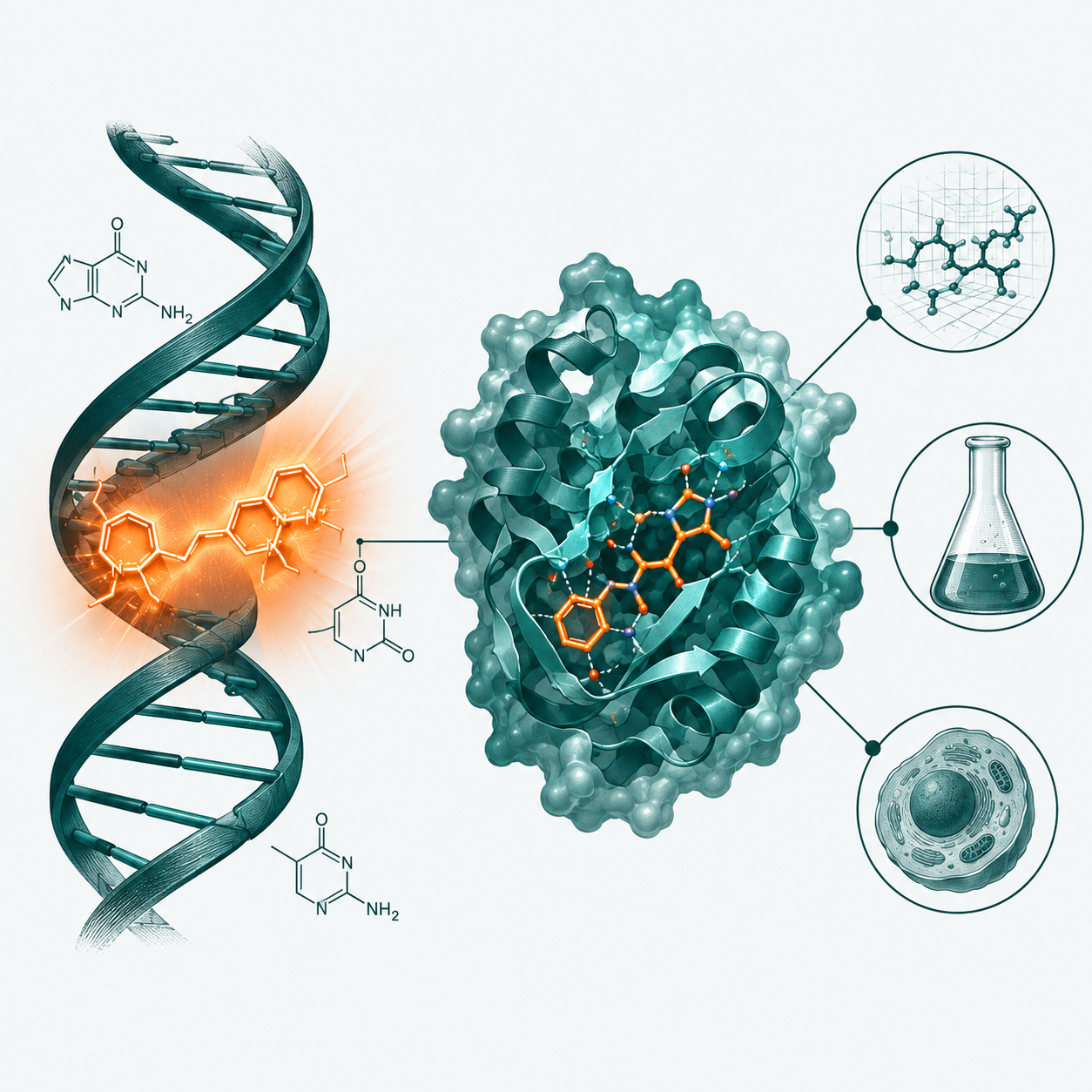
In the early 2000s, the group expanded substantially into rational drug design. Computational modelling, virtual screening, biochemical assays, organic synthesis and hit-to-lead optimization were integrated into a single research workflow spanning target selection, molecular design and experimental validation.
Protein kinase inhibitor discovery—particularly inhibitors of casein kinase 2 (CK2) as potential anticancer leads—became a core programme. The team developed in-house molecular-modelling tools, assembled an organic compound library and identified several novel classes of protein kinase inhibitors.
The team subsequently recognized that single-target drug design is not always sufficient for complex multifactorial diseases such as diabetes and cancer, which involve disrupted networks of interconnected biological processes. This prompted the adoption of multi-target strategies capable of modulating several disease-relevant targets and mechanisms simultaneously.
Medicinal-plant extracts became promising research objects in this context. Their multicomponent composition may modulate several molecular targets, while interactions among bioactive constituents may produce synergistic therapeutic effects. With rigorous standardization and safety assessment, such extracts may combine multi-target activity with comparatively low toxicity. This rationale led to the department’s programme on medicinal plants and their extracts.
Evolution of the Department
In 2006, the unit was renamed the Department of Combinatorial Chemistry. As its research scope expanded and interdisciplinary approaches evolved, it was reorganized as the Department of Biomedical Chemistry on 4 September 2012—a name that more accurately reflects its current integration of medicinal chemistry, chemical biology, biochemistry, molecular biology and pharmacology.
Advanced computational modelling, analytical chemistry, natural-product research and experimental biology were progressively added to the department’s medicinal-chemistry foundations, creating its current interdisciplinary profile.
Major Achievements
Over more than two decades, the department has established a recognized scientific school in medicinal chemistry and chemical biology.
Over this period, department staff have published more than 250 scientific articles, approximately 150 of them in international peer-reviewed journals, obtained 18 Ukrainian and international patents, and completed 16 international and 17 national research projects.
The department has developed novel classes of protein kinase inhibitors, fluorescent probes for nucleic-acid and protein research, in-house computational-modelling and virtual-screening tools, and one of Ukraine’s largest collections of synthetic bioactive compounds.
Training early-career researchers is an important part of the department’s mission. To date, 2 Doctor of Science and 21 Candidate of Sciences (PhD) dissertations have been defended in the department, and its alumni work at research institutions, universities and biotechnology companies in Ukraine and abroad.
These research outcomes have supported international collaborations with leading universities and research centres in Europe and North America and have contributed to both fundamental and applied biomedical research.
The Department Today
From nucleic-acid chemistry and fluorescent probes to a modern interdisciplinary biomedical chemistry platform.Scientific school, Current missionStrategic developmentScientific schoolCurrent mission
The department is an interdisciplinary research centre combining expertise in medicinal chemistry, chemical biology, biochemistry, molecular biology, analytical chemistry and computational modelling. This enables end-to-end research from fundamental concepts to new molecules, analytical methods and technologies for biomedical applications.
Our Approach
We view biomedical chemistry as an interdisciplinary field integrating organic synthesis, medicinal chemistry, computational modelling, chemical biology, biochemistry, molecular biology and advanced analytical technologies. This integration supports both the discovery of new bioactive molecules and original solutions to current biomedical challenges.
Interdisciplinarity, rigorous fundamental research and a commitment to real-world application are central to the department’s work.
Looking Ahead
The department’s strategy focuses on strengthening interdisciplinary research, integrating artificial intelligence and machine learning into bioactive-molecule design, advancing ethnopharmacological research on medicinal plants and developing new drug candidates.
At this difficult time for Ukrainian science, amid the war caused by Russia’s aggression, the department is particularly committed to deeper collaboration and joint projects with Ukrainian research institutions. Pooling intellectual, human and infrastructure resources enables more effective interdisciplinary research despite limited funding and shortages of specialists and modern equipment.
At the same time, expanding international collaboration, participating in European research programmes, training the next generation of scientists and translating fundamental research into pharmaceutical, biotechnology and medical practice remain key priorities.
Building on decades of experience in medicinal chemistry, chemical biology and natural bioactive compounds, the department aims to remain a leading Ukrainian research centre and a trusted partner for the Ukrainian and international scientific communities in developing technologies for the medicine of the future.